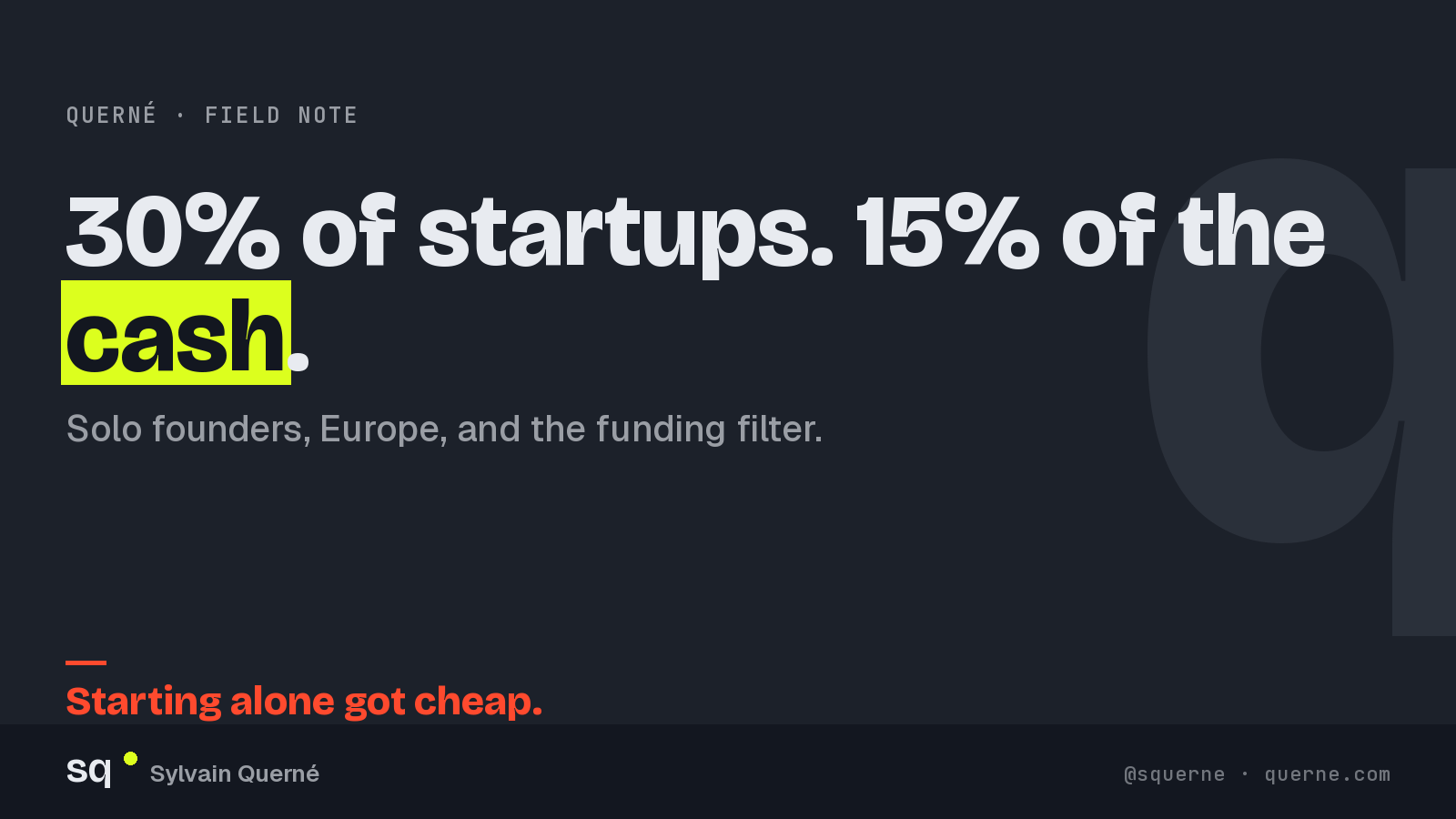
30% of startups, 15% of the cash. Where solo founders Get filtered out
Carta and Cherry Ventures data on who starts alone, who gets funded, and what that means in Europe.
Solo-led companies made up 30% of the startups founded on Carta in 2024. They received 14.7% of the cash raised in priced equity rounds that year.
Roughly half the share of the money. Same market, same tools, same investors.
I build JobMentis mostly solo, with AI doing the execution and me keeping the judgment. So I read that number as a customer of the system, not a spectator.
Solo went from exception to a third of the market
In 2016, 18% of the companies that joined Carta were run by a single founder. In 2025 it was 36%. The share doubled in under a decade, and the Carta analyst behind the figures says the climb accelerated after ChatGPT launched.
That is a correlation, and I would bet there is causation inside it. But the data does not prove it, so I will not pretend it does.
Now the part the headline hides. If 36% are solo, 64% are not. Most founders still start with at least one other person. Solo is not the majority. It is the fastest-moving slice.
One more caveat: Carta only sees companies that issue equity on its platform. Its author suggests the real solo share across all young companies could be higher.
Europe starts even more alone
In October, Cherry Ventures published Heartbeat, a study of 10,000 European companies in their first 18 months. Of those, 75% had one founder. 19% had two. 6% had three or more.
Do not set 75% next to 36% and call it a gap. The populations differ. Cherry includes bootstrapped companies and freezes the picture at 18 months. Carta counts companies that hand out equity, across all ages. Take the direction, not the difference: on both sides of the Atlantic, starting alone is now the common way to start.
One more Cherry detail worth keeping. Founders with US degrees average 2.6 people per founding team. Founders with European degrees average 1.78. Europeans build smaller from day one.
The first round is where solo gets filtered
Here is where Europe gets interesting. Cherry found that 79% of companies with no institutional money are solo-founded. Among those that closed a first funding round, it is 46%.
So between “bootstrapped” and “first cheque”, the solo share falls from roughly four in five to under half. Carta shows the same filter from the other side: around 20% of solo-founder companies end up funded by VCs.
Two readings fit. Investors prefer teams, so solo founders get screened out. Or solo founders add a co-founder in order to raise, so they stop counting as solo. Cherry flags the second one itself: many solos add people later.
Neither dataset can tell you which is happening. Anyone who tells you it is obviously one of them is selling something.
The outcome data does not justify the discount
Carta’s December 2025 analysis says that once funded, solo-founded companies perform about equally to co-founded ones. Solo founders hold 28% of the equity at exit, against 16% for the lead founder in a team. Carta also reports roughly zero failures attributed to co-founder conflict so far. And solo companies make their first hire at a median of 399 days from incorporation, against 480 for multi-founder companies.
Read that with care. The funded solos passed a filter, so equal performance is what you would expect from the ones who got through. Most of the exits in the data were acquisitions. And “so far” is carrying real weight in that conflict number.
So I will not claim solo founders deserve more money. The claim is smaller and harder to wave away: the discount is not obviously earned.
If you are building alone, plan for the filter
Three things I would do with this:
Decide your funding path early. At 18 months, most European companies in Cherry’s sample are solo and unfunded. Bootstrapping is a real route, not a waiting room.
If you raise, answer the team question before anyone asks. AI covers a lot of execution. It does not cover judgment you lack, and an investor is pricing exactly that gap.
Treat the first hire as a deliberate bet. Solo companies wait longer for it, 399 days at the median. Make it the person who removes your biggest single risk.
None of this says go solo or do not. It says know which filter you are walking into.
AI made it possible to start alone. It did not change who gets funded alone. That is still decided by someone writing a cheque.
Starting alone got cheap. Being funded alone did not.