Most interesting post in my feed this week was a fake job posting screenshot.
Screenshots do not need to be true to spread, they need to be believable and slightly outrageous, and those two qualities pull in opposite directions.

Case in point, sitting in my feed this week, three hours old and already reshared past a small publisher’s own follower count: a Yahoo job posting, supposedly demanding 10+ years of experience with Claude Code, a tool that has existed in public preview for about sixteen months. The publisher, a page called CEO Times Magazine, ran it as a trend story. Hiring is broken, AI is warping expectations, the usual shape.
Except the posting is not real, or at least not real in the form that is spreading. The screenshots circulating carry typos an actual Yahoo careers page would not: “Sunyyyvale” for Sunnyvale, “Claued Code” for Claude Code. That is the signature of a garbled aggregator scrape, some job board’s bot mangling a listing on the way through, not a hiring manager’s copy. Yahoo does have a real, live posting for a senior AI-first engineering role. It asks for six years of general experience and lists Claude among several tools a candidate might know. Unremarkable, true, and , as far as I can tell it has been screenshotted by nobody. Understandable.
The joke is older than the tool
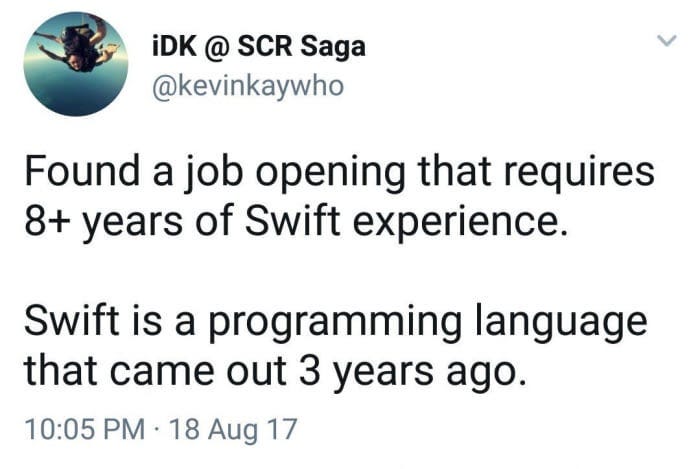
None of this is new, and that is worth sitting with for a second before getting to what is. The “more years of experience than the technology has existed” gag is one of the oldest recurring bits in tech hiring. It ran in 2008 when job postings wanted five years of iPhone development for an SDK that had shipped the year before. It ran again for cloud, for Kubernetes, for the first wave of generative AI in 2023. Now it is running for agentic coding tools. Different technology, same arithmetic error, on a loop that has repeated for two decades.
Here is the part that complicates the easy mockery, though. A year of experience with a fast-moving AI tool is not the same unit as a year of experience with, say, a mature enterprise database. The tool itself has changed shape three or four times in that year. Whoever wrote the original requirement, garbled or not, was reaching for something real: not just “used it,” but “has actually kept up.” The number is impossible. The instinct behind the number is not obviously wrong.
What actually explains the spread
Put the two half-true stories side by side and the interesting question is not “why did this go viral,” it is “why did the true one not.”
The honest answer is dull. The real Yahoo posting is exactly the kind of thing every company is posting right now: reasonable years of experience, familiarity with current tools, nothing to argue about. There is no debate in it, so there is no reason to screenshot it. The garbled version, on the other hand, hands you an easy, shareable outrage in a single image, no reading required, no context needed. A publisher with 1,209 followers does not need the story to be true. It needs the story to be sharp enough that a stranger reposts it without checking, and this one was sharp enough by a wide margin.
That is the actual failure mode, and it has nothing to do with AI specifically. We built an entire distribution system that rewards the version of a claim that requires the least verification and delivers the most immediate reaction, and then we act surprised when the least verified version wins. It was true of chain emails. It was true of the first decade of Twitter screenshots. It is true here.
What to do with a screenshot like this one
Not much honestly, beyond the habit worth building. Before a claim earns a repost, it earns 30 seconds:
does the source look like the primary source
does it look like something that passed through three hands to get to you
typos in a proper noun are a tell
so is a follower count that does not match the confidence of the framing
so is the absence, always, of a link to the thing itself
The real Yahoo posting asked for six years and a working knowledge of Claude. Nobody screenshotted that.