The best post in my feed was a red car in the rain
A red Ferrari, idling on a wet street in a Chinese city, parked between a Porsche Cayenne and a minivan with municipal plates. Nothing about the scene says supercar.
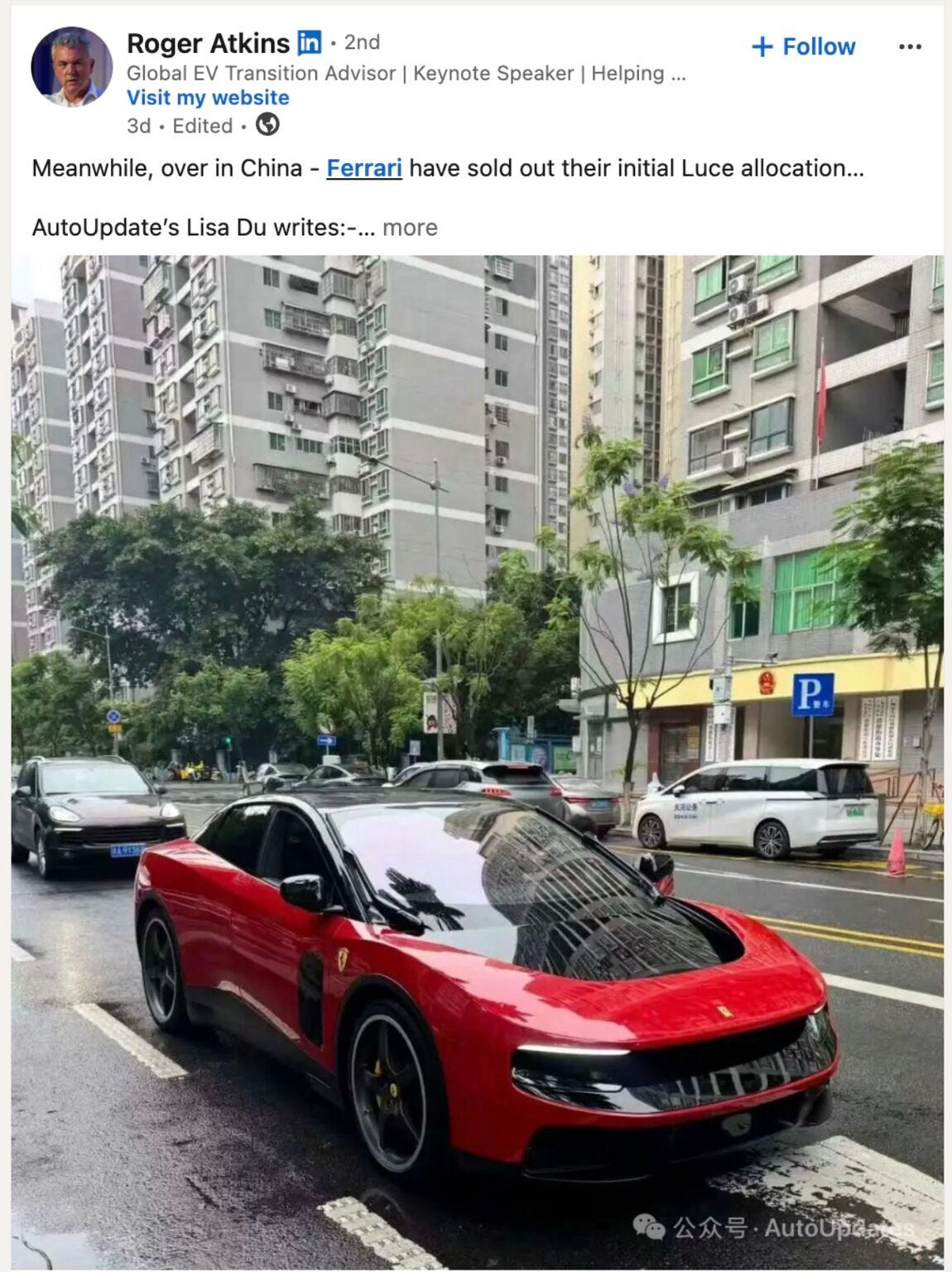
Two months ago Luce cost Ferrari real money. When the Luce, its first EV, was unveiled in May, the reaction was bad enough that Ferrari’s shares fell 8.4% in Milan and 5.1% in New York in a single session.
Ferrari’s own marketing CMO the company expected a polarising reaction, and underestimated the size of it.
By late June the same car, priced at 3,988,000 yuan (roughly $587,000), reportedly sold out its entire first allocation of 88 cars in China within hours.
A launch that cost the company a chunk of its market cap did not get quietly fixed 2 months later. It got fully subscribed, at a price higher than almost anything else Ferrari sells, in the one market least sentimental about what a Ferrari is supposed to look like.
Ferrari didn’t get lucky. The backlash and the sellout are the same strategy, at two different points in the timeline.
First, the part that needs a caveat
Before drawing a lesson from a number, check the number. “Sold out in hours” is the version every outlet ran with, and it may be doing some of the same work the Wimbledon grass photo did a few weeks back: a clean story sitting on top of a real trend.
At least one outlet went back to Chinese dealers after the sellout reports and found some were still quietly taking orders, for a deposit in the hundreds of thousands of yuan to join the first batch. So “sold out” might mean “we are gatekeeping who gets in,” a different and, for this argument, more interesting claim than “every unit is gone.” Either way, the underlying fact holds: demand for the ugliest Ferrari in a generation, at $587,000, in China, was not the problem. It was the headline.
Two real, non-symbolic reasons help explain why China specifically. First, 3988 is a near-homophone in Mandarin for a phrase roughly meaning boundless, lasting prosperity: the price tag itself reads as a lucky number, deliberately or not. Second, as a pure EV the Luce is exempt from China’s 40% consumption tax on combustion cars, a real six-figure saving layered on top of the status play. Not everything here is vibes.
The EV argument is over, and nobody announced it
Two years ago, every Ferrari EV headline led with a version of the same question: can it still be a Ferrari without the engine sound. That question is gone from this cycle. Nobody is debating the powertrain. Every argument about the Luce is about its shape.
That is a bigger shift than it looks. The category anxiety around electric supercars, the thing that would have dominated this launch in 2023, evaporated somewhere in the last two years without a press release. My guess: the next Ferrari EV drifts back toward a more classic silhouette, not because the backlash won, but because the point the Luce needed to make, that Ferrari can build an EV and it will still sell, has already landed. It does not need to keep making that point with every future model.
The target that keeps moving
For five years, ambitious manufacturers have been closing the design gap with the big European marques: hiring serious talent, matching the finish, matching the proportions. Some were getting close enough that “which brand designed this” was becoming a genuine question with the badges covered.
Ferrari’s answer was not to defend the ground it already owned. It put its own crest on the single most unconventional shape it has ever released, in the market best equipped to close a design gap fast. The target for “what does a Ferrari look like” just moved again, and it moved toward Ferrari, not away from it. I would be surprised if genuine Luce-shaped competitors take longer than one product cycle to show up.
What 88 people actually bought
Nobody buying this car needed the extra horsepower. 1,036hp is not a number you use, it is a number you cite. What they bought was scarcer than that: one of 88 confirmed seats, in one country, at a price that filtered out anyone who needed the internet’s approval first.
That is the part most brand launches get backwards. Controversy, handled badly, is just noise. Controversy, handled as a filter, tells you exactly who your category of one is for: the buyer who wants to be first past a line nobody else was brave enough to cross, not the buyer chasing consensus. The Luce did not survive its own backlash. It used it as a qualifying round.
What this means if you are not selling $600k cars
Most founders and brands do the opposite of what Ferrari just did. The moment a bold call gets a rough reception, the instinct is to soften it, round the edges, chase back toward consensus. That instinct protects you from a bad quarter and quietly kills your category of one, because a category of one, by definition, cannot be everyone’s favourite on day one.
The operator version of this lesson is not “be controversial for its own sake.” It is: decide in advance which discomfort you are willing to keep after the room pushes back, and which one you were only pretending to believe in. Ferrari kept the shape. It did not keep pretending the backlash was a surprise for long.
The fiasco was never the car. The fiasco was assuming everyone was supposed to like it.