Why Paying AI-First Leaders Is a Retention Question
PwC, Mercer, Equilar and ZipRecruiter on paying for AI skill, and why it is now a retention question. The AI Premium is 62%, raises are 3.2%.
PwC’s 2026 Global AI Jobs Barometer puts the average wage premium for workers with AI skills at 62%, up from 57% a year earlier.
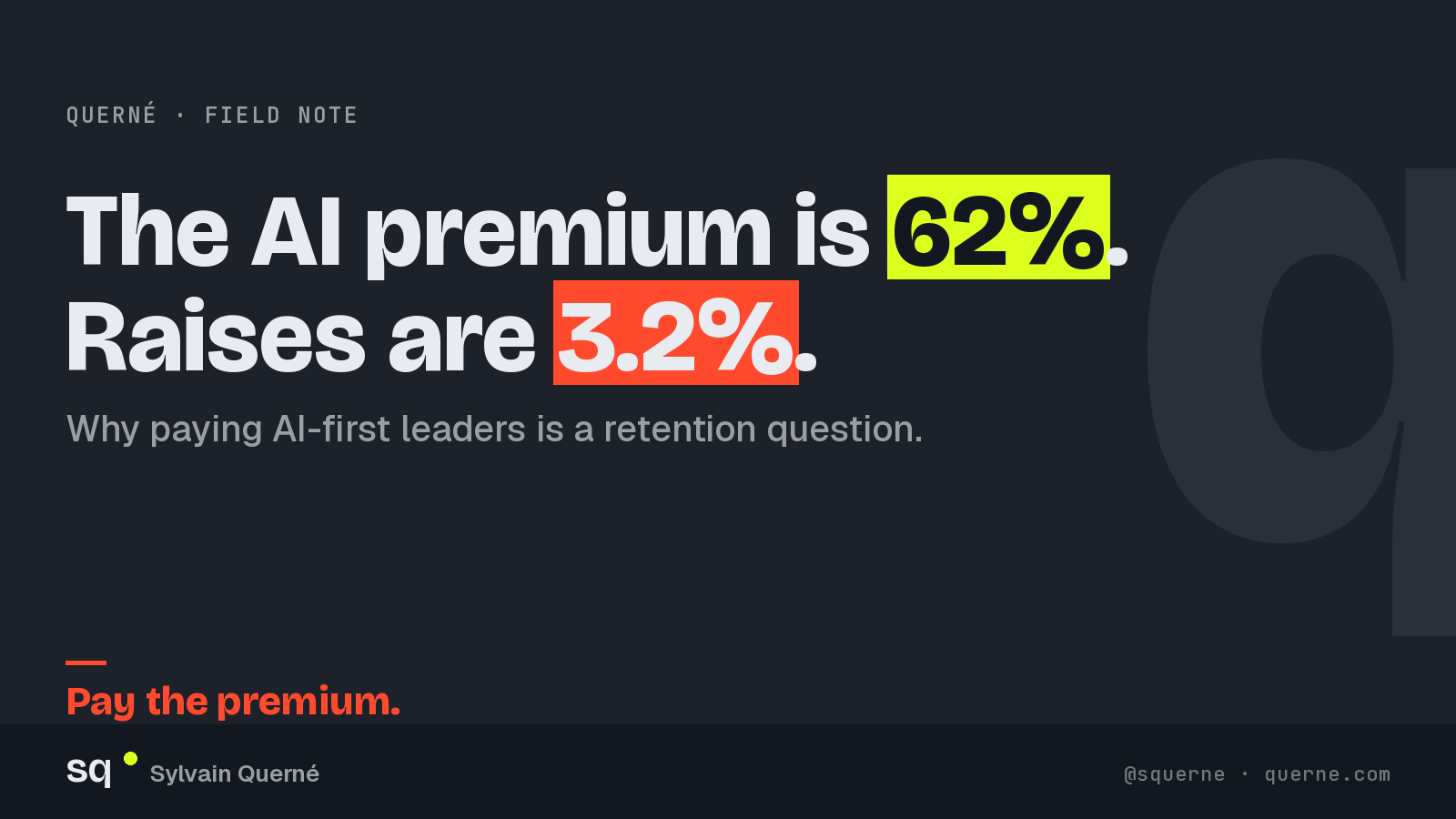
Mercer’s compensation survey says US employers plan merit raises averaging 3.2% for 2026, and most plan to spread them equally rather than steer money to high-demand skills.
They measure different things. One is a price, the other is a policy. Prices move. Policies lag. That gap is where your best people go.
The market has already priced the skill
PwC analysed more than one billion job ads across 27 countries and territories. The premium ranges from 16% in government to 118% in consumer markets.
Lightcast looked at 1.3 billion postings in July 2025 and found 28%, about $18,000 a year, for postings that include AI skills. It also found that 51% of postings requiring AI skills were outside IT and computer science.
Different methods, different numbers. I would not average them. I would take what they agree on: the premium is large, it is growing, and it is no longer a tech-only story.
Nor is this a zero-sum trade. In PwC’s data, the most AI-exposed companies grew headcount 52% against 36% for the least exposed. Wages rose 24% at the most AI-capable companies against 17% at the least. The firms leaning in are hiring more and paying more.
The premium sits at the top, where it is hardest to see
Mercer’s research on AI pay is blunt: the biggest compensation gaps are at the top. Proven AI leaders command the highest premiums, up to 30% over software engineering roles at equivalent levels from P4 upwards. The premium is slight in base pay, moderate in total cash, and considerable in total direct compensation.
Equilar’s October data on Chief AI Officers shows what that looks like. Median total direct compensation is about $1.9M, up from $1.6M the year before. The median pieces: base salary $521,250, annual cash bonus $386,270, time-based stock $385,335, performance incentives $156,804. Most of the package is not base.
Then the number that should worry a CFO. Mercer reports that 91% of surveyed tech total rewards leaders are unsure how to quantify or link the economic value of the AI talent they hire.
Pay is rising fastest for people whose value employers cannot yet measure.
Europe adds a twist. WTW’s May 2026 data on mid-level machine learning experts shows median total compensation above $170,000 in the US, around $122,000 in Germany, and just under $100,000 in the UK. My read, and it is only a read: European employers are buying the same skill at a lower price. That holds until someone with a US budget calls.
1 in 4 workers are weighing an exit over how their company does AI
We used to say people leave managers, not companies. Add another reason to the list.
ZipRecruiter surveyed 1,500+ US workers in September. 25.1% plan to leave their job over their employer’s approach to AI. That is stated intent, not exits, and it is US only. Treat it as a signal, not a forecast.
Look at what kind of signal. It is not simply “give us more AI”. For their next role, 30.5% want less AI involvement and 20.4% want more. People are not leaving over volume. They are leaving over the approach.
And the approach is thin. Only 39.3% say their employer actively encourages AI use. 37.2% learn the tools entirely on their own. 49.9% report higher productivity expectations because of AI.
The benefit is also uneven. 76.5% of senior leaders say AI improved their work satisfaction. For entry-level staff it is 39.8%. The people designing the rollout are the people it helps most.
Someone has to rebuild the ladder AI just removed
PwC looked at 2.4 million US entry-level jobs. AI-exposed entry-level roles are seven times more likely to require traditionally senior skills such as leadership or creativity. Openings for those roles grew 35% since 2019. Other entry-level roles shrank 10%.
Read that as an operator. The junior job did not disappear. It changed, and now it asks for judgment on day one. Somebody has to teach that judgment: which tasks go to the machine, what gets reviewed, how a new hire still learns the craft.
That is the job I mean by an AI-first leader. Not the person who rolls out the tool. The person who redesigns how a team works with it, including how the juniors grow.
I have to be straight about the limit here. I found no dataset showing that paying such leaders better improves retention. The pieces are all there: the premium, the exit intent, the uneven benefit. The link between them is an operator’s inference, not a finding.
Possible moves in this scenario
Price the role off the AI-skill market, not your internal band. If your band says +3.2% and the market says +62%, the band is wrong for this role, not the market. Look at total direct compensation, because that is where the premium lives.
Make the leader accountable for how the team uses AI (not access, not training: USE), including how juniors develop, not for a tool rollout. Rollouts are easy to count. Judgment is what you are paying for.
Stop spreading scarce-skill raises evenly: Mercer calls the gap between flat pay plans and talent priorities a disconnect. Differentiate openly and explain why.
The premium is already being paid. The only question is whether you pay it, or your competitor does, because sooner than later it will determine the rest of the organization’s willingness to stay.